
Stillness carved in stone
Buddha carving in relief and in the round, proportioned for calm.
A Buddha image is read first through its face, hands and posture. Those details are approved before anything else is carved, then the stone, scale and setting are chosen so the piece keeps its quiet from across a room or a garden.
01Made to orderDrawings and references developed for stone.
02Cut and hand-finishedMachined geometry resolved at the carving bench.
03Coordinated supplyApproval, numbering and packing planned for the work.
Three Buddha compositions already carved
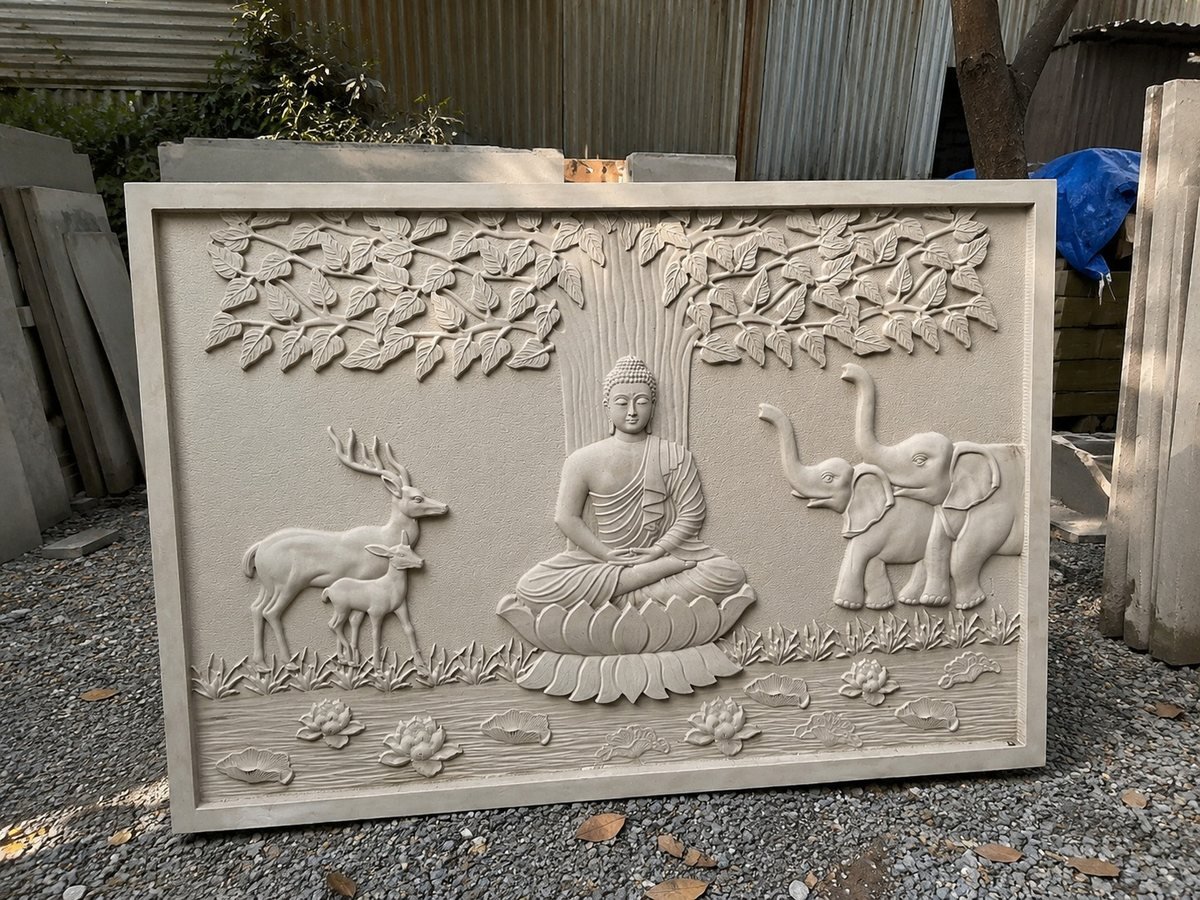
The photographed work includes a Buddha in bloom carved in deep relief on a single beige limestone panel, a beige sandstone scene of the Buddha in a forest with deer, elephants and the bodhi tree, and a white marble Buddha set inside a cut-out ring that echoes the Zen ensō circle.
They show three different registers: a devotional relief for an interior wall, a narrative panel that can live outdoors, and a contemporary composition that relies on outline and negative space.
- Deep-relief Buddha panels
- Narrative scenes with the bodhi tree
- Contemporary cut-out and ensō forms
- Garden and courtyard pieces
- Spa, hotel and meditation-room features
Iconography, proportion and the room
Posture, hand gesture, robe, face and halo follow different conventions across Buddhist traditions. The client approves the reference and these details before carving, and work-stage photographs let the face be corrected while there is still stone to correct it.
Scale is set by viewing distance and height. A figure seen at eye level in a meditation room needs different proportions and depth from one set high in a hotel atrium or low in a garden bed.
Stone, sculpture and supply
Limestone gives a soft, even interior relief; sandstone brings warmth and suits gardens; white marble reads bright and precise; granite is the most durable outdoors but takes fine detail less readily. The photographed Buddha work is relief; free-standing figures are made through the same process as Stonegraph's sculpture, with the block, base and lifting points planned from the start.
Wall panels need their weight and fixing coordinated with the installer; outdoor pieces need drainage and a sound foundation. Pieces are crated for export and installed by the client's local team.
Practical answers
Questions before a stone brief.
- 01Can Stonegraph carve a Buddha from a reference image?
- Yes. A reference can start the design, and the face, hand gesture and posture are approved before carving. Free-standing figures need several views to be interpreted correctly.
- 02Which stone is best for an outdoor Buddha?
- Sandstone or granite is usually recommended outdoors. Marble and limestone suit interiors and sheltered positions.
- 03Does Stonegraph make free-standing Buddha statues or only relief?
- The photographed Buddha work is relief. Free-standing figures are made through the same process as the studio's sculpture, with dimensions, base and lifting planned from the start.
- 04Can a Buddha relief panel be mounted on a wall?
- Yes, when its weight and fixing are coordinated with the installer and the wall construction. Stonegraph supplies the panel weight and dimensions for that design.
Begin with what you have
Send the drawing, dimensions or reference.
Include the setting, preferred stone if known, quantity, delivery location and required date. The workshop can then respond with the missing technical questions.
Stonework directory
Find the right stonework brief.
Material, method and application guides from the Jaipur workshop.